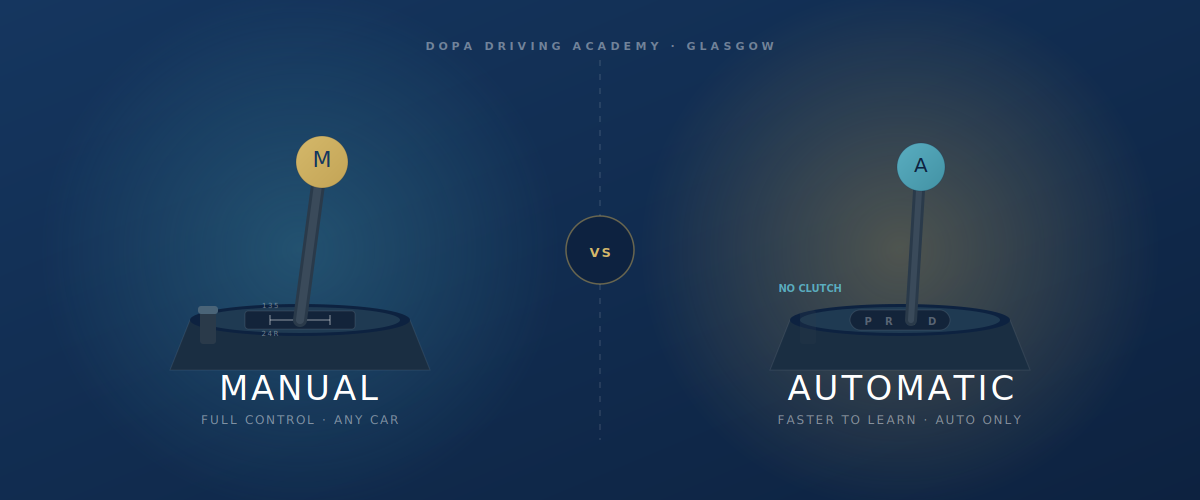
Automatic lessons are faster to learn and easier to pass, while manual gives you a licence that lets you drive any car. There's no universally "right" answer: the better choice depends on your budget, how quickly you want to pass, and what you plan to drive afterwards. This guide breaks down the real differences so you can choose with confidence.
At Dopa Driving Academy in Glasgow, we teach both manual and automatic learners every week, and we get asked this question almost daily. Here's the honest, no-nonsense comparison.
Is it easier to pass your driving test in an automatic?
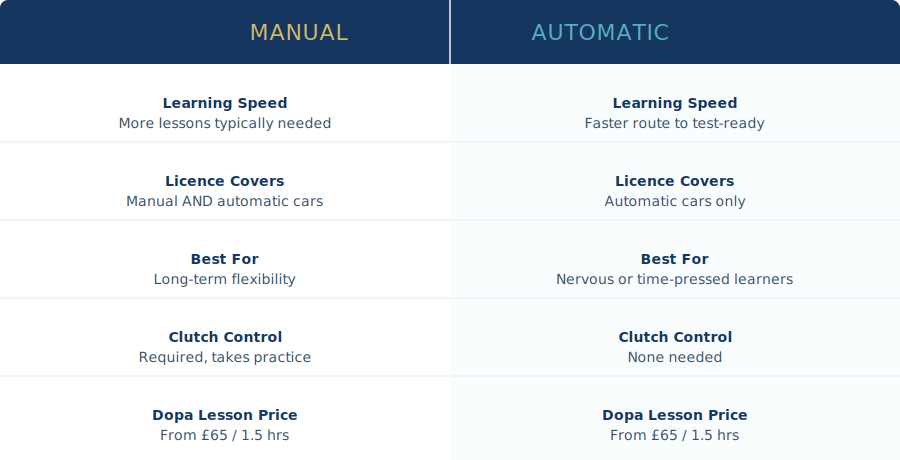
Yes, for most learners. Without a clutch to coordinate or gears to change, you can give your full attention to observation, road positioning, and hazard awareness from lesson one. This is exactly why automatic lessons tend to suit nervous learners or anyone who struggles with multitasking under pressure.
- No stalling: there's no clutch control to master, so junctions and hill starts are far less stressful
- Faster progress: most pupils reach test standard in fewer hours than in manual
- Smoother driving: automatic gear changes mean a calmer, more controlled test performance
Does an automatic licence let you drive a manual car?
No. Passing your test in an automatic restricts your licence to automatic vehicles only. If you later want to drive a manual car, you'd need to take a second test in a manual car, even if you already hold a full automatic licence.
Did you know? Around 1 in 5 UK driving tests are now taken in an automatic, and that share has been rising steadily as more electric and hybrid cars (which are automatic only) enter the market.
Why this matters for your future driving
If you think you'll only ever drive automatic cars, including EVs, this restriction won't affect you. But if you might need to drive a manual at any point, such as borrowing a relative's car or driving abroad, it's worth weighing up manual lessons instead.
How much do manual and automatic lessons cost in Glasgow?
At Dopa Driving Academy, both manual and automatic lessons are priced the same, from £65 per 1.5-hour lesson, with monthly plans from £240. The real cost difference comes from the total number of lessons needed, not the hourly rate.
- Automatic learners typically need fewer total hours, lowering the overall cost
- Manual learners may need more lessons to master clutch control and gear changes
- Factor in car costs too: automatic cars are often pricier to buy or insure long-term
Which is better for new drivers: manual or automatic?
For pure speed to a full licence, automatic wins. For long-term flexibility and resale value on your licence, manual wins, since a manual licence covers both transmission types with no restriction.
At Dopa Driving Academy, we'll talk through your situation honestly in your first lesson and recommend whichever route actually suits you, not just whichever is quicker to book.
Summary
Automatic lessons are quicker and less stressful to learn, but the licence only covers automatic cars. Manual takes a bit longer to master but gives you full flexibility to drive any car, anywhere. Think about what you'll actually be driving once you've passed, and choose accordingly.
If you're looking for driving lessons in Glasgow with a calm, patient, DVSA-approved instructor, book your first lesson with Dopa Driving Academy today. Our 95% pass rate speaks for itself, whichever transmission you choose.